A ball valve is a type of shut-off valve that controls the movement of liquids or gases through a pipeline using a rotating ball with a hole in the center. When the hole aligns with the pipe, media flows through. When the ball rotates 90 degrees, the flow stops completely.
Because of their simple structure, fast operation, and reliable sealing, ball valves are widely used in water treatment, chemical processing, oil and gas, food production, pharmaceuticals, and HVAC systems.
Modern ball valves are available in many materials, including carbon steel, brass, PVC, and stainless steel, making them suitable for both corrosive and high-pressure environments.
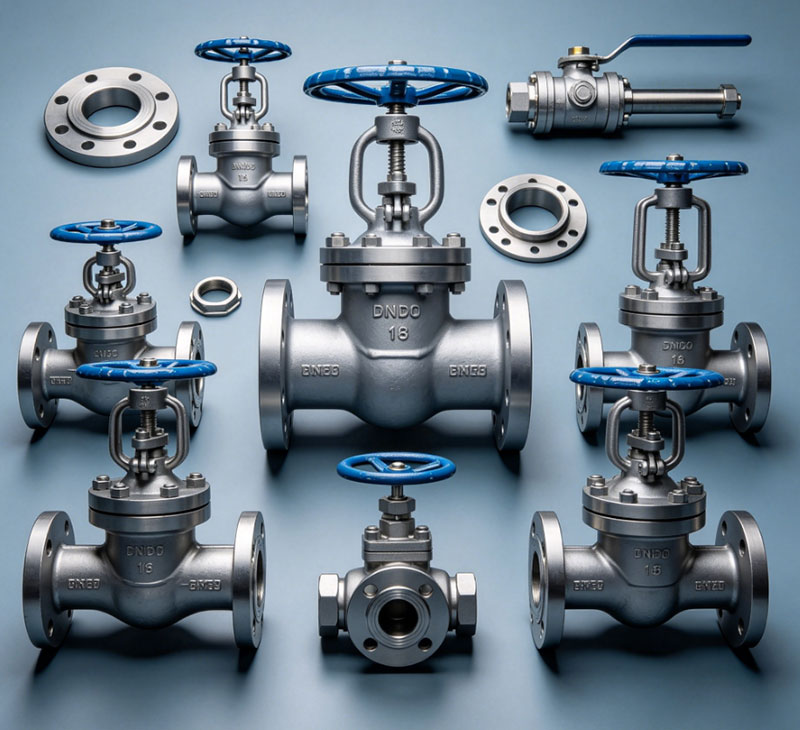
How Does a Ball Valve Work?
A ball valve operates through a quarter turn mechanism.
Inside the valve body is a polished ball with a bore (opening). Turning the handle 90 degrees rotates the ball:
- Handle parallel to the pipeline = valve open
- Handle perpendicular to the pipeline = valve closed
This simple design allows fast opening and closing with minimal effort.
Basic Working Principle
- Media enters the valve body
- The ball rotates through the stem
- The bore aligns or blocks the pipeline
- Seals prevent leakage around the ball
The quarter-turn operation makes ball valves much faster than gate or globe valves.
Main Components of a Ball Valve
Valve Body
The outer shell that contains all internal parts. It may be one-piece, two-piece, or three-piece construction.
Ball
The spherical closure element with a center hole that controls flow.
Stem
Connects the handle or actuator to the ball.
Seats
Soft or metal sealing rings that maintain tight shut-off.
Handle or Actuator
Used for manual or automated operation.
Seals and Packing
Prevent leakage around the stem and body joints.
Types of Ball Valves
Full Port Ball Valve
A full port valve has an internal diameter matching the pipeline size. This design reduces pressure drop and improves flow efficiency.
Common applications:
- Oil and gas pipelines
- Water systems
- Slurry transport
Reduced Port Ball Valve
The internal bore is smaller than the pipe diameter. These valves are lighter and more economical.
Used in:
- General industrial piping
- Utility services
- Low-pressure systems
Floating Ball Valve
The ball is supported by valve seats and slightly moves under pressure to improve sealing.
Best for:
- Medium-pressure applications
- Water systems
- Chemical lines
Trunnion Mounted Ball Valve
The ball is mechanically anchored at the top and bottom.
Suitable for:
- High-pressure systems
- Large pipeline diameters
- Petrochemical plants
V-Port Ball Valve
The ball contains a V-shaped opening for accurate flow control.
Used in:
- Modulating services
- Chemical dosing
- Process control systems
Common Ball Valve Materials
Stainless Steel Ball Valves
Stainless steel ball valves are widely used because they resist corrosion, pressure, and temperature variations.
Advantages:
- Strong corrosion resistance
- Long service life
- Suitable for chemicals and seawater
- Good hygienic performance
Typical grades:
- 304 stainless steel
- 316 stainless steel
Applications:
- Food processing
- Pharmaceutical systems
- Marine environments
- Chemical plants
Brass Ball Valves
Brass valves are common in residential and commercial plumbing.
Advantages:
- Cost-effective
- Easy installation
- Good machinability
PVC Ball Valves
PVC valves resist many chemicals and are lightweight.
Common in:
- Irrigation
- Water treatment
- Chemical transport
Carbon Steel Ball Valves
Designed for high-pressure and high-temperature environments.
Used in:
- Steam systems
- Oil refineries
- Industrial plants
Advantages of Ball Valves
Fast Operation
The quarter turn design allows quick shut-off and opening.
Excellent Sealing
Ball valves provide tight shut-off with low leakage rates.
Low Pressure Drop
Full bore designs allow smooth media flow.
Easy Automation
They can be paired with pneumatic or electric actuators.
Long Service Life
With proper maintenance, ball valves can operate for many years.
Compact Design
They require less installation space compared to many linear valves.
Ball Valve vs Other Valve Types
| Valve Type | Operation | Best Use | Flow Control Capability |
|---|
| Ball Valve | Quarter turn | On/off isolation | Moderate |
| Gate Valve | Multi-turn | Full open/full close | Poor |
| Globe Valve | Multi-turn | Throttling | Excellent |
| Butterfly Valve | Quarter turn | Large pipelines | Moderate |
| Check Valve | Automatic | Prevent backflow | None |
Ball Valve Applications
Ball valves are used across many industries because of their durability and reliable shut-off performance.
Oil and Gas
- Pipeline isolation
- Fuel transfer systems
- Refining equipment
Chemical Processing
- Corrosive media handling
- Acid transfer
- Solvent systems
Water Treatment
- Pump systems
- Filtration units
- Distribution networks
Food and Beverage
- Hygienic process lines
- CIP systems
- Beverage filling equipment
Pharmaceutical Industry
- Sterile processing
- Clean fluid handling
- High-purity systems
HVAC Systems
- Chilled water lines
- Heating systems
- Air handling equipment
Manual vs Automated Ball Valves
Manual Ball Valves
Operated using a lever handle.
Advantages:
- Simple operation
- Lower cost
- Easy maintenance
Pneumatic Ball Valves
Powered by compressed air.
Advantages:
- Fast response
- Suitable for hazardous environments
- Common in industrial automation
Electric Ball Valves
Driven by electric actuators.
Advantages:
- Precise control
- Remote operation
- Easy integration with control systems
How to Choose the Right Ball Valve
Consider the Media
Check whether the fluid is:
- Corrosive
- Abrasive
- High temperature
- High pressure
Select the Correct Material
For corrosive applications, stainless steel or lined valves are often preferred.
Determine Valve Size
The valve size should match the pipeline diameter and flow requirements.
Understand Operating Conditions
Evaluate:
- Temperature range
- Pressure rating
- Flow rate
- Installation environment
Choose the Right Connection
Common end connections:
- Threaded
- Flanged
- Welded
- Tri-clamp
Decide Between On/Off or Flow Control
Standard ball valves are mainly for isolation, while V-port designs provide better flow control performance.
Maintenance Tips for Ball Valves
Proper maintenance extends valve lifespan and improves operational reliability.
Regular Inspection
Check for:
- Leakage
- Corrosion
- Worn seals
Operate Periodically
Opening and closing the valve regularly prevents sticking.
Clean Internal Components
Remove buildup that may affect sealing performance.
Replace Damaged Seats
Worn seats can cause leakage and poor shut-off.
Lubricate Moving Parts
Some industrial valves require periodic lubrication.
Signs a Ball Valve Needs Replacement
You may need to replace a ball valve if you notice:
- Persistent leakage
- Difficult handle movement
- Internal corrosion
- Reduced sealing performance
- Cracked body or stem damage
FAQs
What is a ball valve used for?
A ball valve is mainly used to start, stop, or isolate fluid flow in a pipeline. Some specialized designs also support limited flow control.
Why are ball valves called quarter-turn valves?
They open or close with a 90-degree rotation of the handle or actuator, which is known as a quarter turn operation.
Are stainless steel ball valves better than brass?
Stainless steel ball valves generally offer better corrosion resistance, higher pressure tolerance, and longer service life, especially in industrial environments.
Can a ball valve regulate flow?
Standard ball valves are mainly for on/off service. V-port ball valves are designed for more accurate flow regulation.
What industries use ball valves?
Ball valves are widely used in oil and gas, water treatment, chemical processing, pharmaceuticals, food production, marine systems, and HVAC applications.
How long does a ball valve last?
The service life depends on material quality, operating conditions, and maintenance. Industrial ball valves often last many years under normal operation.
Conclusion
Ball valves are among the most widely used industrial valves because of their simple structure, reliable sealing, and fast quarter turn operation. Whether used for shut-off service or basic flow control, they offer dependable performance across a wide range of industries.
From residential plumbing to chemical processing plants, selecting the correct material and valve design helps improve system efficiency, durability, and safety. For demanding environments, stainless steel ball valves remain one of the most common choices due to their corrosion resistance and long operational life.